"Yovie" Cultural Center
Overview
A performance hall that breaks its container, making structure, material, and movement part of the performance itself.
Site
Where
It Sits
A perimeter block on the Ringstrasse, ringed by heavy nineteenth-century masonry. The building holds its ground through layered transparency rather than matching the mass of its neighbours.
Concept
"The construction lines share the same angular ratios as the acoustic propagation angles of the Goldener Saal: geometry and acoustics become the same thing."
From this single geometric correspondence, the two auditoriums were sized and oriented. The building does not decorate structure; it reveals it. Every material decision traces back to performance: acoustic plaster absorbs, oak panels diffuse, mesh filters light without sealing the street.
Worm's-Eye Axonometric
Seen From
Below
Two concert halls inserted behind a retained Viennese facade, seen from below. The cut runs just under the steel trusses, so the whole steel system reads from below over the two ribbed halls, held inside the retained facade and the glass envelope. The neighbouring blocks, streets and trees come from the site model.

Exploded Axonometric
Lifted
Apart
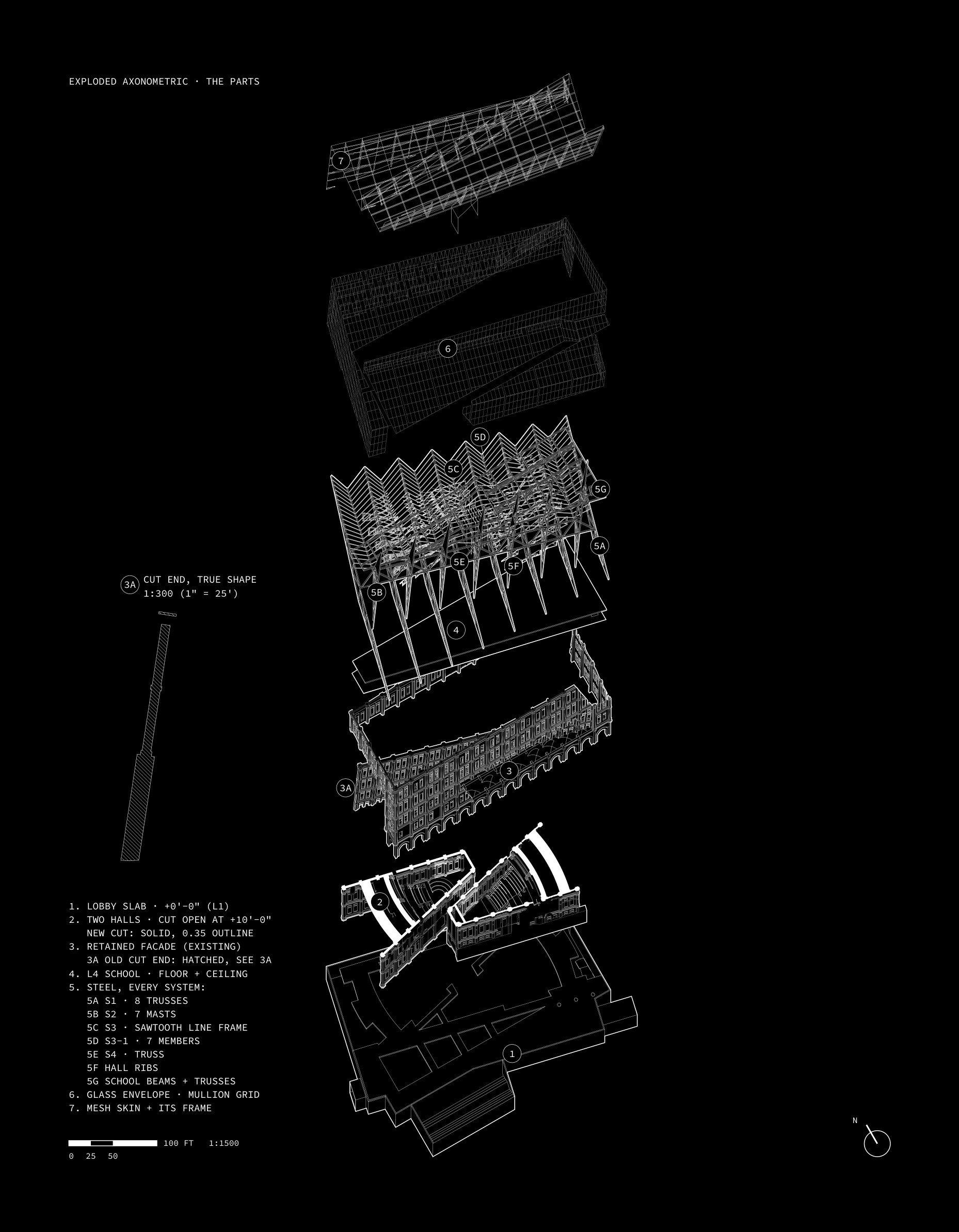
The building taken apart into seven parts. One stays: the retained facade, its old cut end drawn in true shape. Everything else is inserted: the lobby slab, the two halls, the school above them, every steel system, the glass envelope and the mesh skin.
Process Camera X-Ray
From Object
to Architecture
The object was first built compositionally with an AI agent assembling camera components as an architectural study. The assembly was then modeled in 3D with actual camera parts and re-fed to a second AI agent, downloaded from GitHub, to generate the X-ray.
From the X-ray, the path of light through the camera's lens and mirror system was studied and compared to the behavior of sound in performance space. The angles of reflection in the camera's mirrors became the conceptual generator, translated architecturally into how sound reflects, refracts, and amplifies through the auditorium volume.
Plans
Assembly
Logic
The plan reveals two auditoriums flanking a shared lobby atrium: you enter at grade and see all levels simultaneously. The section shows how the long-span steel truss creates column-free performance volumes spanning the full building width.
Both drawings are governed by the same organisational spine: a central void that separates and connects the two performance halls.


Section

Acoustics
Sound
in the Hall
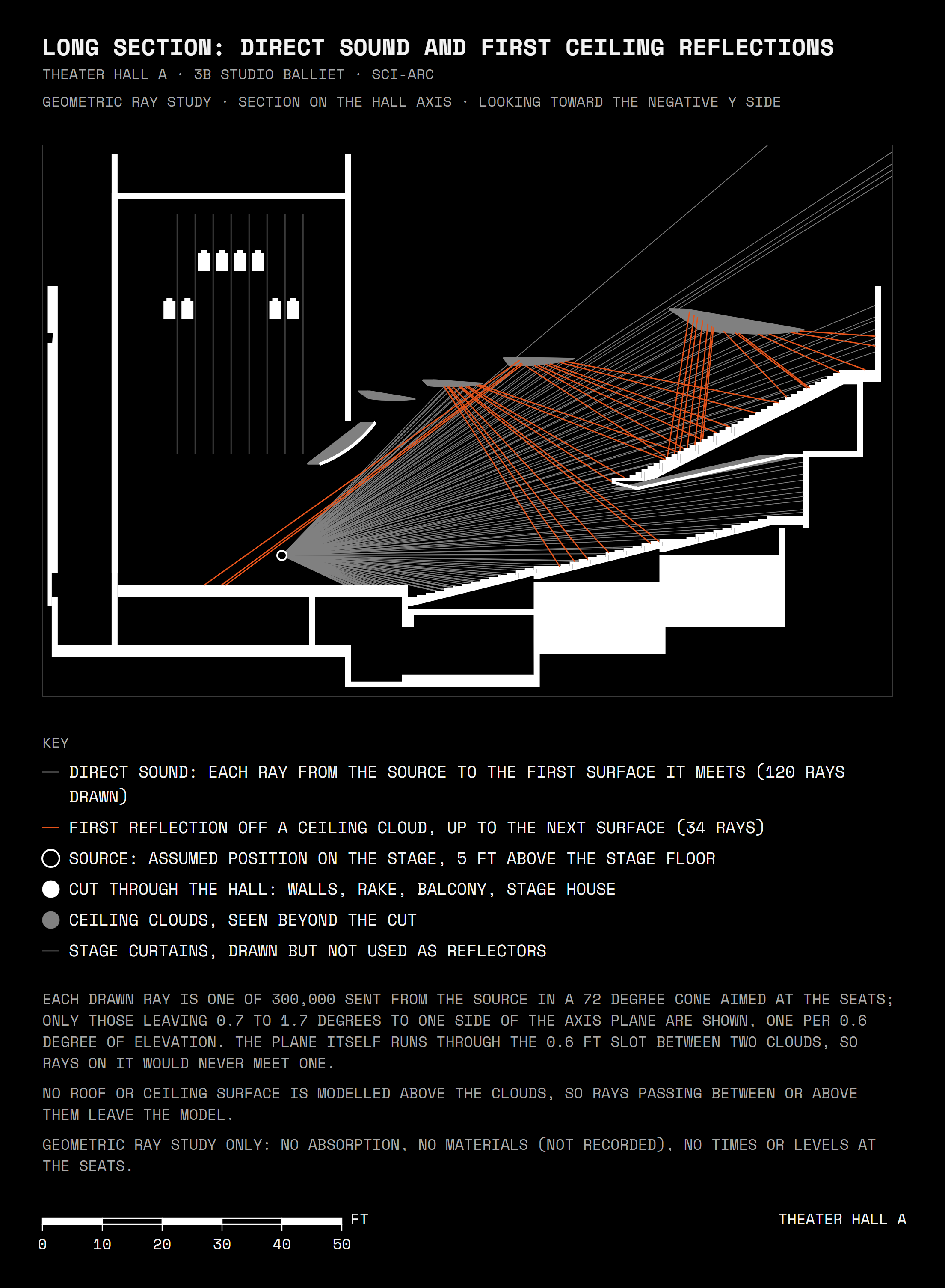
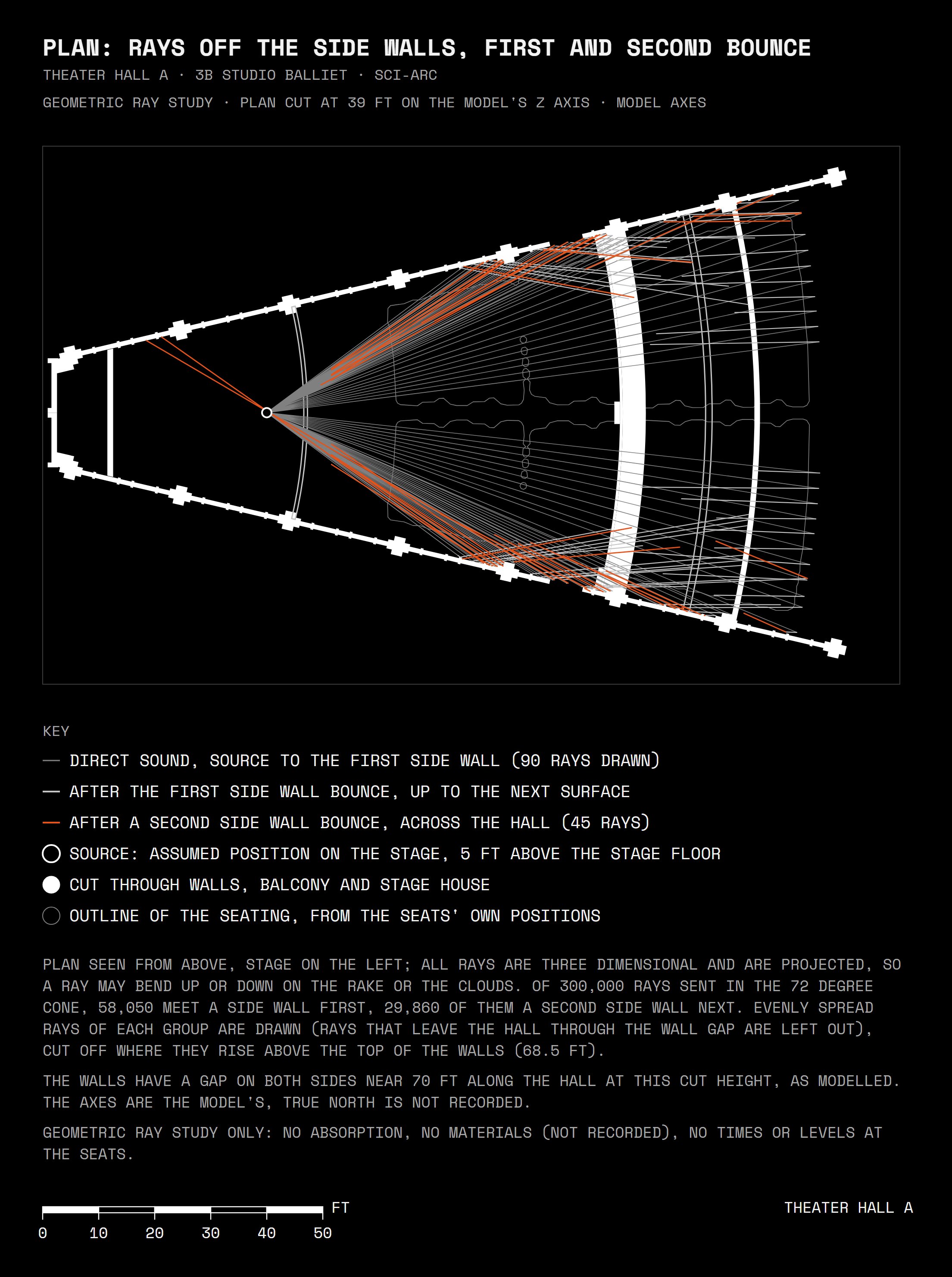
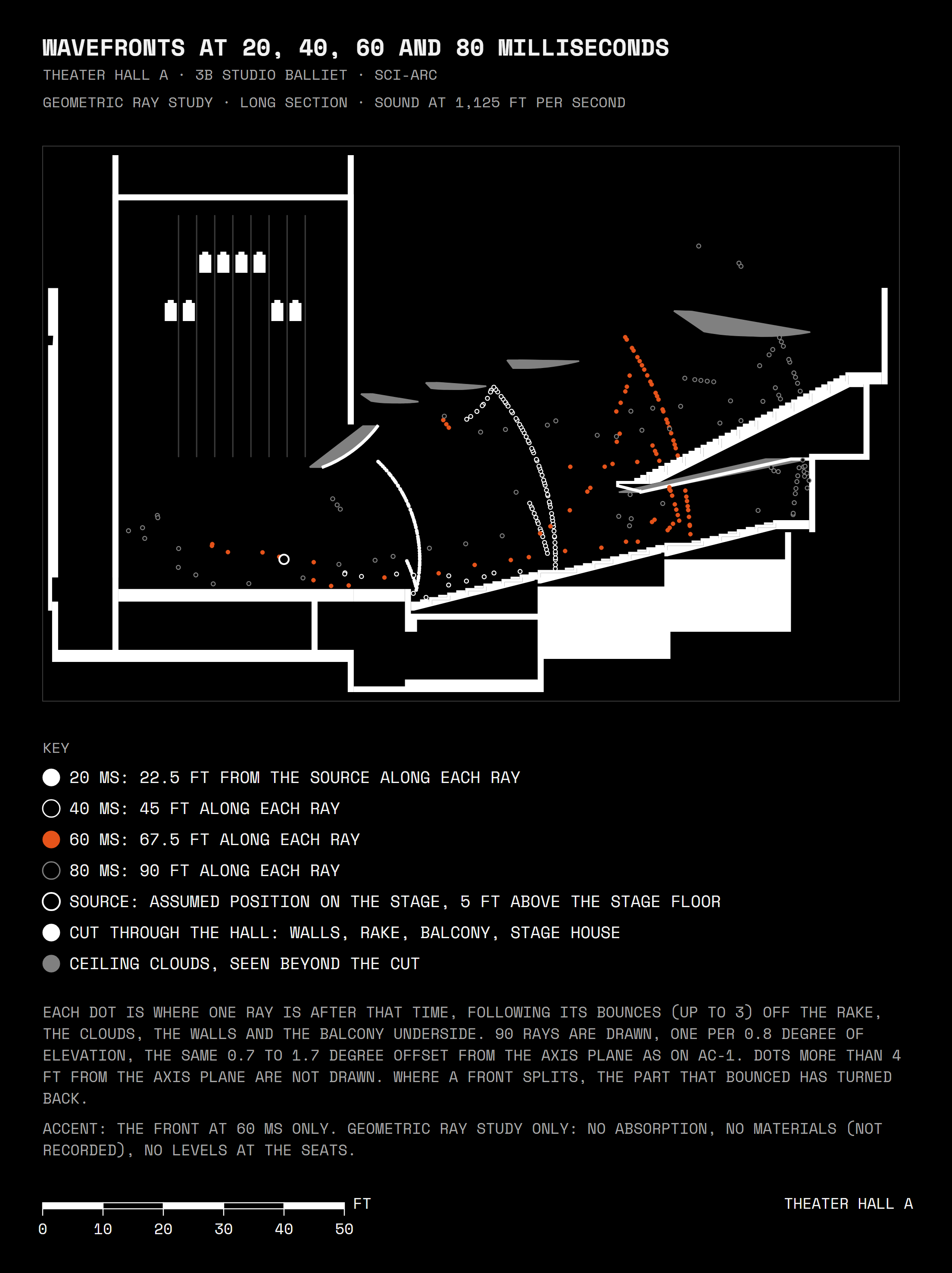
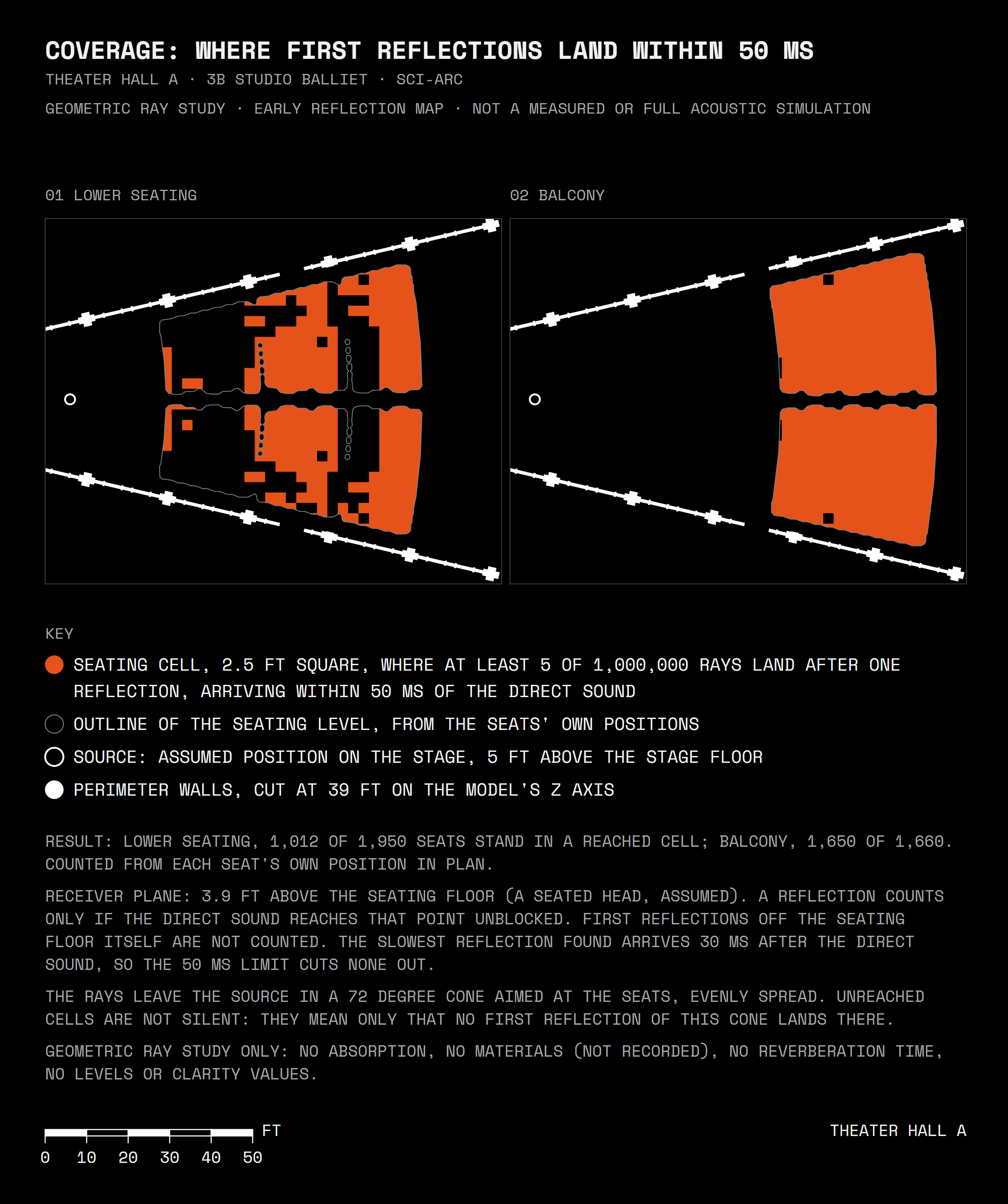
A ray study of one of the two halls, traced through the hall's own surfaces in the class model: where sound from the stage goes first. Off the ceiling clouds in section, off the side walls in plan, the sound front at 20 to 80 milliseconds, and where the first reflections reach the seats within 50 milliseconds. It is geometry only, with no absorption or materials, so it shows paths and timing, not loudness.
Diagrams


Render
Atmosphere
and Form
The auditorium interior is shaped by the same geometric logic as the building's exterior: the acoustic geometry of the Goldener Saal is translated into the section's curvature and the ceiling's panelling rhythm.
At night, the structural frame reads through the mesh skin from outside, reversing the building's opacity.

Additional Views
.jpg)
.jpg)
Presentation Boards
Final
Submission
The final submission boards covering site context, structural assembly, façade system, egress strategy, and mass motion analysis.


Physical Model
Built at
1/8″ Scale
The model makes the building's fractured logic tangible: two auditorium volumes held within a single structural frame, separated by the central lobby void. The steel truss reads as a spine from which everything else hangs.
At this scale the mesh façade becomes a texture: the building dematerialises at its edges and condenses at its structural core.

Model All Views


Site Model
Assembly
Sequence
A smaller-scale model built to understand the building within its urban context. The black base is a printed aerial map of the site in Vienna, making the relationship between the building's footprint and the surrounding city block immediately readable.
The assembly sequence reveals the interior logic: two auditorium volumes in red, the structural frame in white, the roof peeling back to expose the section.

Assembly Sequence


